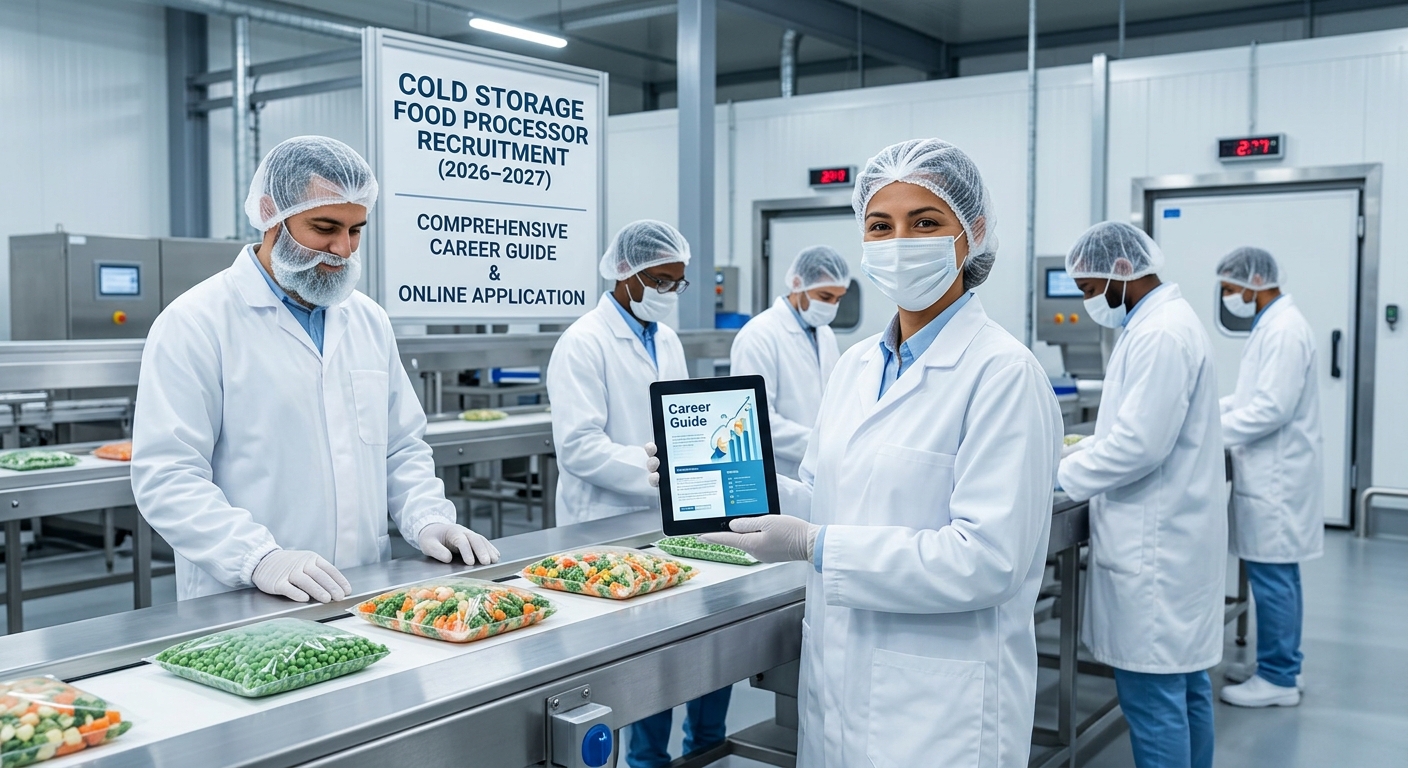
The global food manufacturing, processing, and cold-chain supply sector is experiencing significant expansion through 2026 and 2027. Driven by increasing demand for fresh produce, packaged meats, dairy products, and frozen consumer foods, the role of a Cold Storage Food Processor has become essential to modern food distribution and agricultural supply chains.
Whether you are looking to secure steady entry-level employment or seeking structured growth within food warehouse operations, this guide outlines the primary responsibilities, eligibility requirements, expected compensation, and submission procedures for the 2026–2027 hiring cycle.
What Does a Cold Storage Food Processor Do?
A Cold Storage Food Processor works directly within climate-controlled production facilities, agricultural processing plants, and cold-chain warehouses. The primary goal is to safely process raw ingredients—including meats, seafood, poultry, dairy, fruits, and vegetables—while strictly keeping within temperature-controlled environments to preserve quality, extend shelf life, and enforce food safety regulations.
Key Responsibilities
- Ingredient Handling & Processing: Sort, wash, trim, portion, and slice raw food ingredients on automated assembly and processing lines.
- Cold-Chain & Temperature Monitoring: Assist in tracking climate conditions within low-temperature zones (typically ranging from $0^\circ\text{C}$ to $-20^\circ\text{C}$ / $32^\circ\text{F}$ to $-4^\circ\text{F}$) to strictly align with health and safety standards.
- Machinery & Equipment Operation: Safely handle industrial production machinery, including automated slicers, vacuum sealers, shrink wrappers, and conveyor systems.
- Sanitation & Hygiene Standards: Maintain compliance with Hazard Analysis Critical Control Point (HACCP) rules, Good Manufacturing Practices (GMP), and facility sanitation guidelines.
- Packaging & Inventory Staging: Label, package, seal, and palletize processed goods for organized cold-room storage or immediate refrigerated distribution.
Eligibility Criteria & Qualifications (2026–2027)
Most hiring facilities maintain low barriers to entry for general production roles, alongside structured advancement paths for technical personnel.
| Qualification Category | Requirement Details |
| Educational Attainment | High School Diploma, Metric/Intermediate, or equivalent vocational training (Certificates in Food Technology are an added advantage). |
| Experience Level | 0 to 2+ years in food manufacturing, warehouse operations, or cold-chain facilities (Entry-level candidates and freshers are accepted). |
| Physical Demands | Capacity to work comfortably in cold/freezing rooms, stand for extended shift durations, and safely lift up to 25 kg (50 lbs). |
| Certifications | Basic Food Safety, HACCP awareness, or GMP orientation certificates are highly valued. |
| Key Attributes | Strong manual speed, attention to detail, team collaboration skills, and strict adherence to hygiene protocols. |
Key Advantages of Cold Storage Careers
- Consistent Employment Stability: Food production and cold-chain operations represent essential infrastructure, offering stable employment regardless of economic fluctuations.
- Clear Career Growth: Entry-level processors can transition into line leads, shift supervisors, Quality Assurance (QA) technicians, or warehouse operations managers.
- Competitive Wages & Allowances: Offers competitive hourly rates with opportunities for paid overtime, night shift premiums, and holiday bonuses.
Application Preparation & Submission Steps
Before applying for open positions during the 2026–2027 recruitment cycle, ensure you prepare the following:
- Updated Resume / CV: Highlight physical capabilities, past production or warehouse roles, and any food safety accreditations.
- Identification: Have valid government-issued identification ready for background verification.
- Medical Clearance: Obtain standard medical fitness verification confirming your ability to work inside low-temperature facilities.